
Signs a house heating system needs flushing
A heating system doesn't clog up overnight. Sludge build-up is a slow process that starts invisibly and first shows itself as a rising heating bill even though the rooms aren't any warmer.
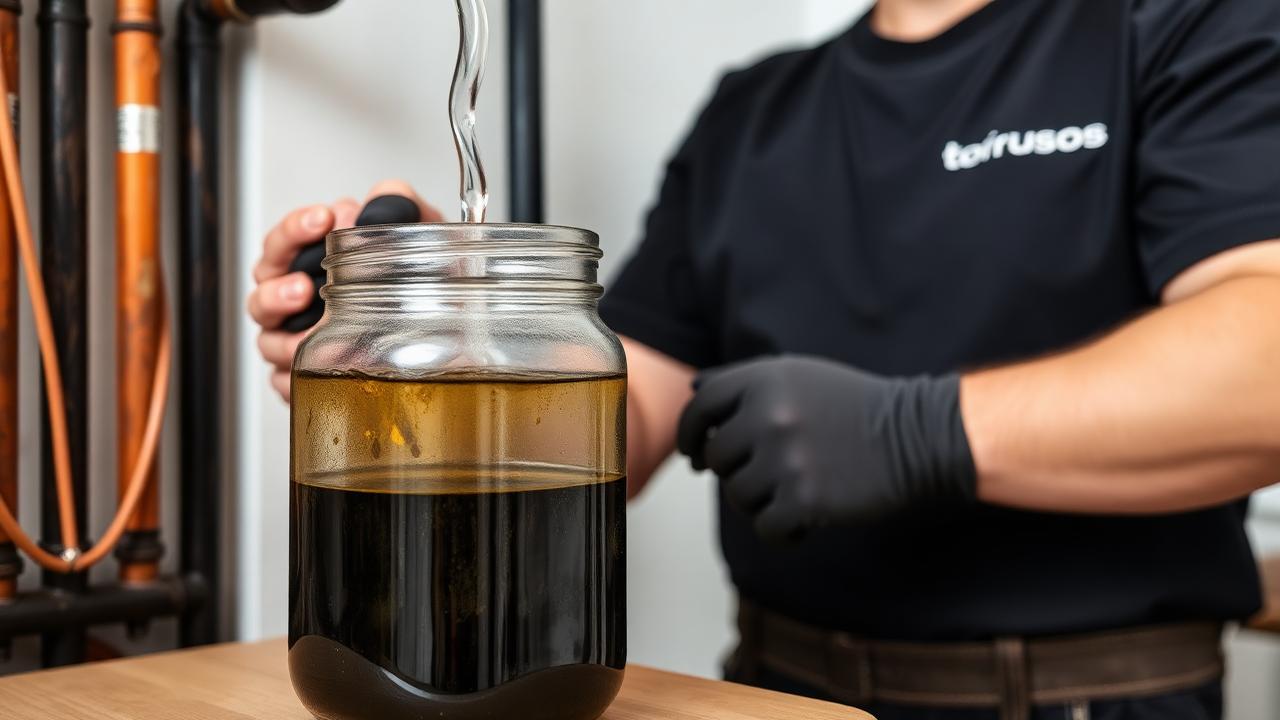
In a closed heating circuit, magnetite gradually forms — a black iron-oxide sludge that results from corrosion and oxygen ingress.
Below are practical signs any homeowner can use to judge whether the system needs flushing, and what to check before deciding.
Six signs to watch for
One sign alone doesn't necessarily mean flushing is needed. Three or more together almost always does.
- Radiators heat up unevenly — some are hot, others only lukewarm
- The bottom of a radiator stays cold even though the top is warm (sludge has settled at the bottom)
- The circulation pump is noisy, runs hot, or occasionally cuts out
- Bleeding a radiator produces black water instead of clear
- The system needs bleeding much more often than before
- The heating bill has risen even though settings and habits haven't changed
The glass jar test
Let a little water from the bleed valve run into a clear glass jar and leave it to settle for a couple of minutes. Clear or slightly yellowish water is fine. Dark, grey or black water with a fine black powder settling at the bottom indicates magnetite.
Why sludge build-up happens in the first place
The main cause is oxygen. Every time fresh water is added to the system — after a leak, a repair, or restoring pressure — it brings oxygen with it, which reacts with the steel.
A second cause is the coexistence of different metals: steel, copper and aluminium in the same circuit speed up electrochemical corrosion if there's no inhibitor in the water.
A third cause is long-term use without any maintenance at all. A 15–20 year old system that has never been flushed is almost always sludged up.
What sludge build-up actually costs
A radiator full of sediment doesn't release heat across its whole surface. In practice this means the boiler has to run longer to heat the same room.
The pump has to move a thicker fluid, uses more electricity, and wears out faster. Premature pump replacement is a typical cost of a sludged-up system.
Sediment also damages the heat exchanger and valves — repairs to these are far more expensive than flushing itself.
What to check before deciding on a flush
Before ordering a flush, it's worth ruling out simpler causes, since the symptoms partly overlap.
- Is there simply air in the system — check the bleed valves
- Are the thermostatic heads working and the pins moving freely
- Is system pressure normal both cold and hot
- Are the radiator valves balanced, rather than turned at random
If all of these are fine
If all four points check out and radiators still heat unevenly, a flush is justified. For the service itself, see heating system flushing.
How to keep the system clean after flushing
Fit a magnetic filter to catch circulating iron particles. It's emptied once a year during servicing.
Avoid adding water unnecessarily. Every top-up brings in oxygen — if pressure keeps dropping, look for the leak rather than just topping up.
Add a corrosion inhibitor if the system design calls for it, and check it during servicing.
Frequently asked questions
Related services
Need a professional?
Toru SOS responds fast across Tallinn, Harju county and all of Estonia.
- Plumbing work
- Drain unblocking
- CCTV pipe inspection
- High-pressure jetting
- 24/7 emergency service