
Why does a heating system expansion vessel need checking?
The expansion vessel is the quietest part of a heating system. It makes no noise, demands no attention, and works unnoticed for years — until it fails. Then the whole system's pressure becomes unpredictable.
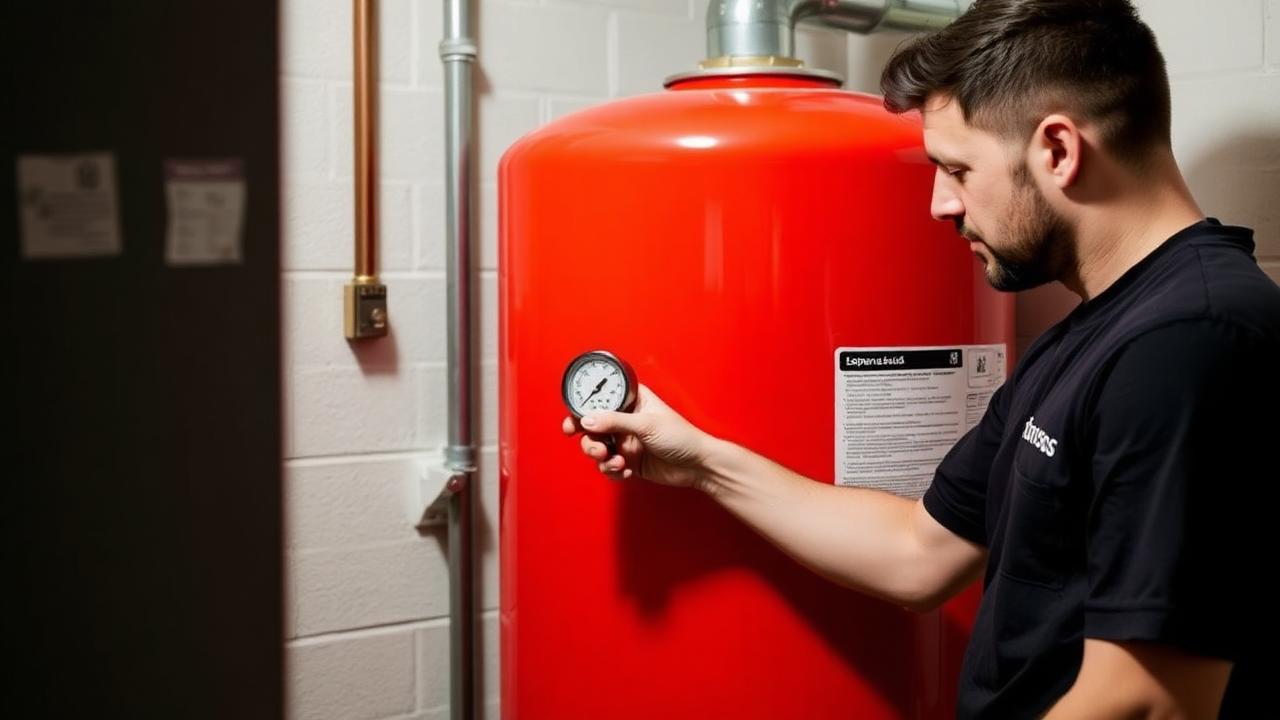
The expansion vessel's job is simple: heating water expands as it warms, and the vessel absorbs that change in volume. Without a working vessel, pressure would swing dangerously up and down with every heating cycle.
Below we look at how to check the vessel's condition and how to decide whether it needs replacing.
How an expansion vessel works
Inside the vessel is a rubber membrane. On one side is heating water, on the other compressed air, whose pre-charge is usually factory-set to around 1.0–1.5 bar.
As the water heats up and expands, it pushes on the membrane and compresses the air. As it cools, the membrane moves back. The whole balance depends on the air side being at the right pressure and the membrane being intact.
Signs the vessel isn't working
A failing expansion vessel doesn't announce itself directly — it shows up in how pressure behaves.
- Pressure rises sharply while heating and drops just as sharply while cooling
- The safety valve releases water every time the system heats up properly
- Pressure drops to almost zero when the system is completely cold
- The vessel feels evenly warm all over when touched (a healthy vessel's top is normally cooler)
- Water, not air, comes out of the vessel's air valve when checked
Water at the air valve is the final answer
If you press the tyre-valve-like nipple on the vessel and water comes out, the membrane is torn. This kind of vessel can't be repaired — it needs replacing.
How to check the pre-charge
The check is always done with the system depressurised and cold, otherwise the water side pushes on the membrane and gives a false reading.
The system is depressurised, the pressure on the vessel's air side is measured with a gauge, and topped up if needed with an ordinary pump to the level specified by the manufacturer.
In an apartment building and at the heat substation, this is always a technician's job, since other systems are connected there too.
How often to check it
It's worth checking a house expansion vessel's pre-charge once a year — ideally before the heating season alongside boiler servicing.
An expansion vessel typically lasts 8–15 years. A vessel that has already lost its pre-charge once will lose it again.
If the system also has pressure that's too high or pressure that keeps dropping, the expansion vessel is the first place to look for an answer.
The wrong size vessel is just as bad as a faulty one
An expansion vessel's capacity is calculated from the system's water volume and temperature regime. A vessel that's too small is constantly overloaded and its membrane wears out quickly.
If the system has since been extended — extra radiators or underfloor heating loops added — a vessel that was correctly sized originally may now be too small. This often goes unnoticed until pressure starts to fluctuate.
Frequently asked questions
Related services
Need a professional?
Toru SOS responds fast across Tallinn, Harju county and all of Estonia.
- Plumbing work
- Drain unblocking
- CCTV pipe inspection
- High-pressure jetting
- 24/7 emergency service